Can a Solar Generator Power an Air Conditioner in Nigeria? (Honest Answer)
This is one of the most searched solar questions in Nigeria right now — and unfortunately, it is also one of the most poorly answered ones online. Most articles either give you a vague “it depends” and leave you more confused than before, or they are written by people in America or Europe who have no idea what electricity in Nigeria actually looks like.
So let us have a real conversation about this.
Can a solar generator power an air conditioner in Nigeria? The short answer is: it depends on the size of your solar generator and the type of AC unit you own — and for most of the portable solar generators Nigerians commonly buy, the honest answer is no, at least not reliably or for a meaningful length of time.
But that is not the end of the story. There is a lot more to unpack here, and by the time you finish reading this guide, you will know exactly what size solar system you actually need to run AC in Nigeria, what the realistic costs look like, and what smarter alternatives exist if a full solar-powered AC setup is currently out of your budget.
Why This Question Matters So Much in Nigeria
Nigeria sits almost directly on the equator. In cities like Lagos, Abuja, Port Harcourt, and Kano, temperatures regularly climb above 35°C from March through October. For a lot of Nigerian families, an air conditioner is not a luxury — it is genuinely necessary for sleep, for productivity, and for the health of children and elderly family members.
The problem is NEPA. Power supply in most Nigerian homes averages anywhere from 4 to 12 hours a day in the best areas, and far less in others. Running a petrol generator through the night just to keep an AC on has become one of the biggest household expenses for middle-class Nigerian families — fuel costs, maintenance, noise, fumes, and the security risk of running a generator outside at night.
So it is completely understandable that when people discover solar generators, the first question they ask is: “Can this finally let me sleep with my AC on without spending a fortune on fuel?”
The answer requires understanding a few key numbers first.
The Power Numbers: What an AC Actually Needs
This is where most people get surprised — and where a lot of sellers of cheap solar equipment prefer you stay confused.
Air conditioners are among the most power-hungry appliances in any Nigerian home. Here is why:
A standard 1.0 horsepower (1HP) split unit air conditioner — the most common size in Nigerian bedrooms — consumes approximately 750W to 900W of power when running. But here is the part most people do not know: when an AC compressor first starts up, it draws a surge current that can be 3 to 5 times its running wattage for 1 to 3 seconds.
That means a 1HP AC that runs at 800W can demand a startup surge of up to 3,000W to 4,000W from your power source. If your solar generator cannot handle that surge, it will either trip its overload protection, shut down, or — in worst cases — damage its internal components.
Let us look at common AC sizes and their real power demands:
AC Size Running Wattage Startup Surge (approximate) Hours to drain a 150W generator battery
0.75HP split unit 550W – 650W 1,500W – 2,500W Less than 1 hour
1.0HP split unit 750W – 900W 2,500W – 4,000W Less than 45 minutes
1.5HP split unit 1,100W – 1,300W 3,500W – 5,500W Less than 30 minutes
2.0HP split unit 1,500W – 1,800W 5,000W – 7,500W Cannot start at all on small systems
Now compare those numbers to what most portable solar generators sold in Nigeria offer:
Solar Generator Size Continuous Output Peak/Surge Output Can it power a 1HP AC?
150W solar generator 150W 300W – 400W No
300W solar generator 300W 600W – 800W No
500W solar generator 500W 1,000W – 1,200W No (insufficient for startup surge)
1,000W – 1,500W solar generator 1,000W – 1,500W 2,000W – 3,000W Possibly a 0.75HP inverter AC, with conditions
2,000W+ solar generator 2,000W+ 4,000W+ Yes, a 1HP inverter AC reliably
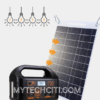
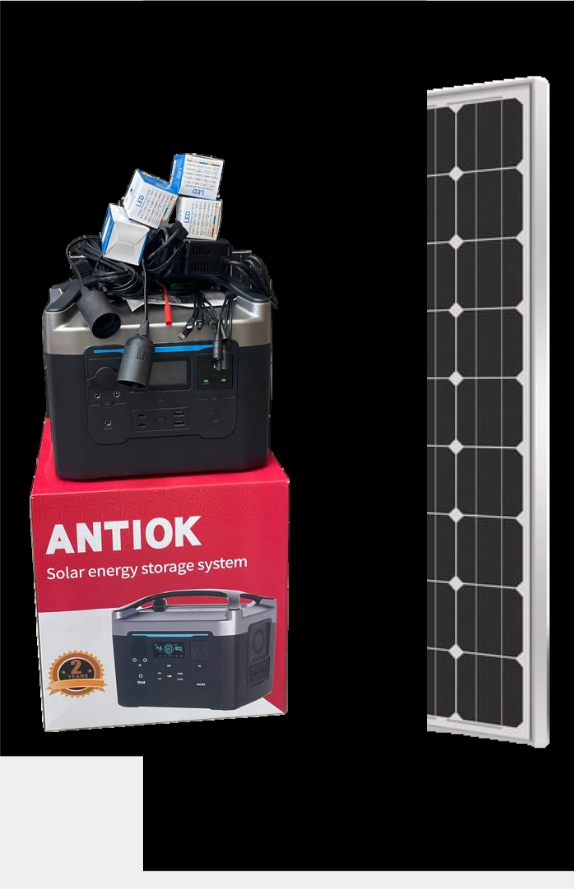
The numbers tell the story clearly. The popular 150W, 300W, and even 500W solar generators that most Nigerian families buy — which are excellent for fans, TVs, lights, decoders, laptops, and phone charging — simply do not have the capacity to start or sustain an air conditioner.
What About Inverter Air Conditioners? Does That Change Things?
Yes — and this is an important distinction that many Nigerians are now becoming aware of.
A conventional (non-inverter) AC has a compressor that is either fully on or fully off. Every time it kicks in, it draws that massive startup surge. This is brutal on any power source, including solar generators.
An inverter air conditioner works differently. Its compressor runs at variable speeds, ramping up gradually rather than switching on at full power all at once. This means the startup surge is much lower — sometimes as little as 1.5 times the running wattage instead of 3 to 5 times. Inverter ACs also consume significantly less electricity overall, often 30% to 50% less than a conventional AC of the same size.
For solar power purposes, inverter ACs are the only type worth seriously considering. If you are planning to run your AC on solar in Nigeria, pairing a large solar generator or solar system with an energy-efficient inverter AC is the way to go.
Popular inverter AC brands available in Nigeria include Hisense, Midea, LG, Scanfrost, and Panasonic. A quality 1HP inverter AC from any of these brands will consume roughly 500W to 650W during normal running — down significantly from a conventional unit — making it more feasible for a sufficiently sized solar system to handle.
So What Solar System Size Do You Actually Need to Run AC in Nigeria?
Let us be practical and specific, because this is the question that matters.
To run a 1HP inverter AC in a typical Nigerian bedroom for 8 hours overnight, here is roughly what you need:
- Solar panels: Minimum 600W to 800W of solar panels to charge the battery adequately during the day
- Battery capacity: Minimum 100Ah at 24V (approximately 2,400Wh) — a 150W or 300W portable generator has nowhere near this capacity
- Inverter/output capacity: Minimum 1,500W continuous output with at least 3,000W peak surge capacity
- Charge controller: A good MPPT charge controller rated to handle your panel array
In practical terms, you are looking at a dedicated solar power system — not a portable solar generator. This is the kind of setup that involves wall-mounted battery banks, large rooftop or ground-mounted panels, and a proper inverter unit. It is a significant installation, not a plug-and-play device.
The cost of such a system in Nigeria in 2026, installed by a qualified solar company, typically starts from around ₦600,000 to ₦1,200,000 depending on the number of AC units, usage hours, and battery type (AGM vs lithium). That is a serious investment — but for families spending ₦30,000 to ₦60,000 per month on petrol generator fuel just to run an AC, the payback period can be as short as 18 to 24 months.
What Can a Portable Solar Generator Actually Do for Your AC Problem?
Here is where we want to give you a genuinely useful answer rather than just telling you what your portable solar generator cannot do.
Even though a 150W, 300W, or 500W solar generator cannot power your AC unit, it can still make the heat problem more manageable in several smart ways:
1. Power a High-Quality Solar Fan Instead
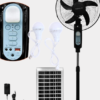
A good solar standing fan — like the 16-inch solar rechargeable fan available at MyTechCiti — consumes only 20W to 40W of power. That is less than 5% of what a 1HP AC uses. A 150W solar generator can run a solar fan for 6 to 10 hours easily on a full charge. While a fan is not the same as AC, a powerful fan in a small room with good airflow makes sleeping in Nigerian heat far more bearable than many people expect.
2. Run a Portable Evaporative Air Cooler
Evaporative coolers (sometimes called “air coolers” or “desert coolers”) are not as powerful as AC units, but they consume only 60W to 150W and can drop room temperature by 4°C to 8°C in reasonably dry conditions. A 300W solar generator can run one of these for 4 to 6 hours overnight. They work best during the dry season when humidity is lower — which is also when Nigerian heat is most intense.
3. Use Your Portable Solar Generator for Everything Else — and Save Your Petrol Generator for AC Only
This is actually the smartest approach for most Nigerian households right now. Use your portable solar generator for all your low-power appliances — TV, decoder, fan, lights, laptop, phone charging — and only run your petrol generator when you specifically need the AC. This can reduce your generator fuel consumption by 50% to 70%, saving you thousands of naira every month while you save up for a full solar installation.
A Realistic Solar AC Plan for Nigerian Homes: Step by Step
If your long-term goal is to eventually run your air conditioner on solar power, here is a practical roadmap that does not require you to spend everything at once:
Step 1 — Start with a portable solar generator (where most people are now). Use it for fans, lights, TV, and phone charging. Reduce your petrol generator dependence significantly from day one.
Step 2 — Switch to an inverter AC. When your current conventional AC needs replacement, do not buy another conventional unit. Invest in a 1HP inverter AC. It will immediately cut your AC electricity consumption by 30% to 50%, whether running on NEPA, a fuel generator, or eventually solar.
Step 3 — Plan your solar upgrade. Start getting quotes from reputable solar installation companies in your city. A properly sized system for one bedroom AC plus general household loads might cost ₦700,000 to ₦1,000,000 fully installed with good lithium batteries.
Step 4 — Install in phases if budget requires. Many solar companies in Nigeria will allow you to start with panels and a smaller battery bank, then add more batteries over time as your budget allows. Even a partial solar system that handles all your non-AC loads frees up your fuel generator purely for AC use, dramatically cutting fuel spend.
Red Flags to Watch Out For When Shopping Solar for AC in Nigeria
As solar power has grown in popularity across Nigeria, so have misleading claims from some vendors. Here are things to be cautious about:
- “This 500W solar generator can power your AC” — It cannot. Do not buy from anyone making this claim. A 500W generator will trip or get damaged trying to start even the smallest AC unit.
- Unusually cheap “solar AC systems” — A genuine solar system capable of running AC overnight requires serious battery capacity and quality inverters. If someone is quoting you ₦150,000 for a complete solar AC setup, ask very specific questions about the battery capacity in amp-hours and the inverter’s surge rating.
- Chinese-spec panels with inflated wattage ratings — Some solar panels sold in Nigerian markets are labelled 200W or 300W but only deliver 60% to 70% of that in real-world conditions. Always buy panels from reputable brands or sellers with transparent specifications.
- No mention of inverter AC compatibility — Any solar installer worth dealing with will specifically ask whether you plan to run an inverter AC and will size your system accordingly. If they are not asking these questions, be cautious.
Final Verdict: Can a Solar Generator Power AC in Nigeria?
Let us wrap this up cleanly.
A portable solar generator in the 150W to 500W range — the type most commonly sold in Nigeria and the type stocked at MyTechCiti — cannot power a standard air conditioner. The power gap between what an AC demands and what these generators provide is simply too large, particularly when you factor in startup surge current.
However, a properly sized, dedicated solar power system — with 600W or more of panels, a large battery bank, and a quality inverter — absolutely can power an inverter AC overnight. It is done successfully by thousands of Nigerian homes and businesses every day. It just requires a proper installation that goes beyond a portable solar generator.
For most Nigerian households today, the smart path forward is using a portable solar generator for all your non-AC loads immediately, dramatically cutting fuel costs, while planning a phased investment toward a full solar system for AC over time.
That approach saves you money starting from day one, protects you from being sold something that cannot deliver what you need, and gets you to a genuinely solar-powered home in a financially sustainable way.
If you are ready to start that journey — whether with a portable solar generator for your fans and appliances, or you want to discuss what a larger solar setup might look like — explore our range of solar generators and panels at MyTechCiti. We have options from 150W all the way up to 500W with included solar panels, and we are always happy to help you find the right fit for your home and budget.
Frequently Asked Questions
Can a 500W solar generator power a 1HP AC in Nigeria?
No. A 500W solar generator does not have enough continuous output or startup surge capacity to run a 1HP air conditioner. A 1HP AC requires 750W to 900W to run and up to 4,000W of surge power at startup. You would need a dedicated solar inverter system of at least 1,500W to 2,000W capacity to reliably power a 1HP inverter AC.
What is the cheapest solar setup to run AC in Nigeria?
The most affordable way to run AC on solar in Nigeria is to pair a 1HP inverter AC (which consumes less power) with a solar system comprising at least 600W of solar panels, a 100Ah 24V lithium battery bank, and a 1,500W pure sine wave inverter with MPPT charge controller. Expect to budget at least ₦600,000 to ₦800,000 for a quality installation in 2026.
Is an inverter AC better for solar power in Nigeria?
Yes, absolutely. An inverter AC uses significantly less electricity than a conventional AC — often 30% to 50% less — and has a much lower startup surge. This makes it far more compatible with solar power systems. If you are planning to run AC on solar in Nigeria, an inverter AC is not optional, it is essential.
Can I use a solar generator to reduce my AC fuel costs in Nigeria?
Yes, indirectly. Even though a portable solar generator cannot run your AC, it can power all your other appliances — fans, TV, lights, phone charging — so that you only need to run your petrol generator specifically for the AC. This strategy alone can cut your monthly fuel spending by 50% to 70%.
How many solar panels do I need to run a 1HP AC in Nigeria?
To run a 1HP inverter AC for 8 hours overnight using solar energy stored during the day, you typically need 600W to 800W of solar panels in good Nigerian sunlight conditions (5 to 6 peak sun hours per day). This assumes a properly sized battery bank and an efficient MPPT charge controller to capture maximum energy from the panels.